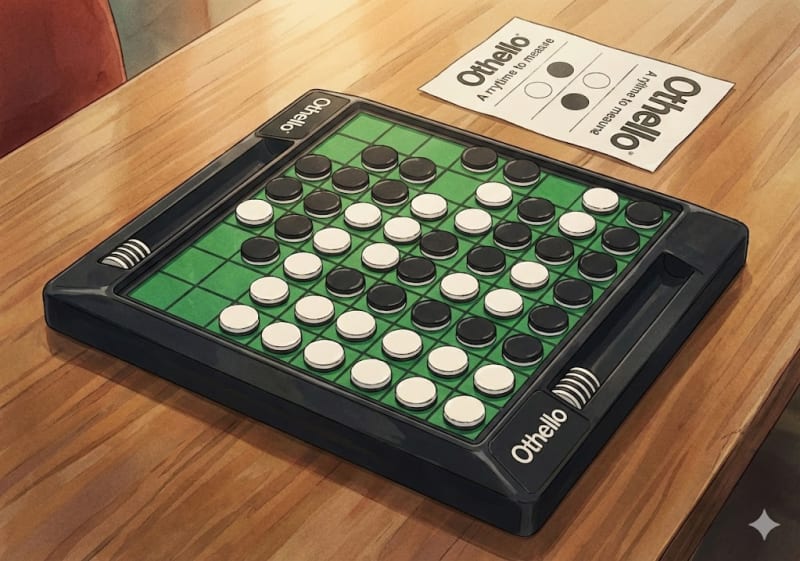
When there are 10 squares left on the Othello board, the game enters a critical phase. This is where games are won and lost, and where accurate counting becomes essential. Learning to predict the final score with 10 squares remaining is a skill that separates intermediate players from experts. Master this, and you'll dramatically improve your endgame performance.
Why 10 Squares Matters
The 10-square mark is significant because:
- Perfect Calculation Becomes Possible: With only 10 empty squares, you can calculate all possible game outcomes with reasonable effort.
- Games Are Often Decided: By this point, the position is usually clear—one player is winning, and the question is by how much.
- Mistakes Are Costly: Every move matters. A single error can turn a winning position into a losing one.
- Time Management: In timed games, knowing how to count quickly at this stage is crucial.
Expert players can often predict the final score accurately when 10 squares remain, allowing them to make optimal decisions and avoid unnecessary risks.
The Basics of Endgame Counting
Endgame counting involves calculating all possible game outcomes from the current position. Here's the fundamental approach:
- Count Current Discs: First, count how many discs each player currently has.
- Identify Empty Squares: List all empty squares and understand which player can potentially claim them.
- Calculate Variations: For each possible move sequence, calculate the final disc count.
- Find the Best Outcome: Determine the best possible result for each player with perfect play.
With 10 squares, this calculation is manageable. With practice, you can do it quickly and accurately.
Understanding Parity
Parity is crucial for endgame counting. Parity refers to who will make the last move:
- Even Parity: The player who didn't start will make the last move. This often favors the second player in the endgame.
- Odd Parity: The player who started will make the last move. This can be advantageous or disadvantageous depending on the position.
- Parity Switches: Moves that don't flip discs (pass moves) can change parity, which is critical in endgame calculation.
Understanding parity helps you predict who will control the final squares and calculate the end result more accurately.
Step-by-Step Counting Method
Here's a systematic method for counting with 10 squares remaining:
- Count Current Score: Count discs for both players. For example, Black: 32, White: 22 (54 total, 10 empty).
- List Empty Squares: Identify all 10 empty squares and note their positions (e.g., a1, b2, c3, etc.).
- Group by Control: Determine which squares each player can potentially claim. Some squares might be contested.
- Calculate Best Case: For each player, calculate their best possible outcome assuming optimal play.
- Account for Parity: Factor in who will make the last move and how that affects the final squares.
- Verify: Double-check your calculation by working backwards from the final position.
Common Patterns at 10 Squares
Recognizing common patterns makes counting faster and more accurate:
- Corner Control: If one player controls corners, they usually win. Count the stable discs around those corners.
- Edge Dominance: Long stable edges often determine the winner. Count the discs along stable edges.
- Isolated Squares: Empty squares that are isolated (surrounded by one color) are easy to count—they'll go to that player.
- Contested Areas: Groups of empty squares where both players can move require deeper calculation.
- Pass Moves: Positions where one player must pass can dramatically change the outcome—account for these.
Practical Counting Example
Let's work through a simplified example:
- Current Score: Black has 30 discs, White has 24 discs. 10 squares remain empty.
- Empty Squares: 6 squares are isolated and will clearly go to Black (surrounded by black discs). 4 squares are contested.
- Contested Squares: In the contested area, with optimal play, Black can claim 2, White can claim 2.
- Parity: Black will make the last move, so Black gets the final contested square.
- Final Calculation: Black: 30 + 6 + 2 + 1 = 39. White: 24 + 2 = 26. Black wins by 13.
This is simplified, but the principle applies: count stable gains, calculate contested areas, and factor in parity.
Tips for Accurate Counting
Improve your counting accuracy with these tips:
- Start with Stable Discs: Count discs that can't be flipped first—these are certain.
- Work in Groups: Group empty squares by area and calculate each group separately.
- Use Parity: Always check who will make the last move—it often determines the final contested squares.
- Double-Check: Verify your count by calculating from different angles or working backwards.
- Practice Regularly: Set up positions with 10 squares and practice counting. Speed and accuracy improve with repetition.
- Account for Passes: Don't forget that pass moves change parity and can affect the outcome.
When Counting Gets Complex
Some positions are harder to count. Here's how to handle them:
- Multiple Contested Areas: Break them down into separate calculations and combine the results.
- Complex Parity: When parity is unclear, calculate both scenarios (if Black moves last vs. if White moves last).
- Forcing Sequences: Look for moves that force specific responses—these simplify calculation.
- Time Pressure: In timed games, estimate quickly rather than calculating perfectly. Practice helps you estimate accurately.
Using Counting to Make Decisions
Accurate counting helps you make better endgame decisions:
- When You're Winning: If you're ahead, simplify the position and avoid unnecessary risks.
- When You're Losing: If you're behind, look for ways to complicate the position and create counting errors.
- When It's Close: Precise counting helps you find the move that maximizes your score.
- Time Management: If counting shows you're winning, you can play quickly. If it's unclear, take time to calculate carefully.
Practice Exercises
Improve your counting with these exercises:
- Set Up Positions: Create positions with exactly 10 empty squares and practice counting the final score.
- Play Endgames: Start games from positions with 10 squares and practice counting before each move.
- Use Engines: Set up positions, count them yourself, then check with an engine to verify your accuracy.
- Time Yourself: Practice counting quickly. In real games, you need speed and accuracy.
- Study Master Games: Look at how experts handle endgame positions and try to count along with them.
Common Counting Mistakes
Avoid these common errors:
- Forgetting Parity: Not accounting for who makes the last move is a frequent mistake.
- Overlooking Pass Moves: Pass moves change parity and can dramatically affect the outcome.
- Counting Unstable Discs: Don't count discs that can still be flipped—only count stable ones.
- Missing Contested Squares: Failing to properly calculate contested areas leads to errors.
- Rushing: Taking shortcuts in calculation leads to mistakes. Be systematic.
Key Takeaway
Mastering endgame counting with 10 squares remaining is essential for serious Othello improvement. Learn to count current discs, identify empty squares, calculate contested areas, and factor in parity. Practice regularly by setting up positions and counting them, then verify with engines. Accurate counting helps you make optimal endgame decisions, avoid mistakes, and convert winning positions. With practice, you'll be able to predict final scores quickly and accurately, giving you a significant advantage in endgame play.