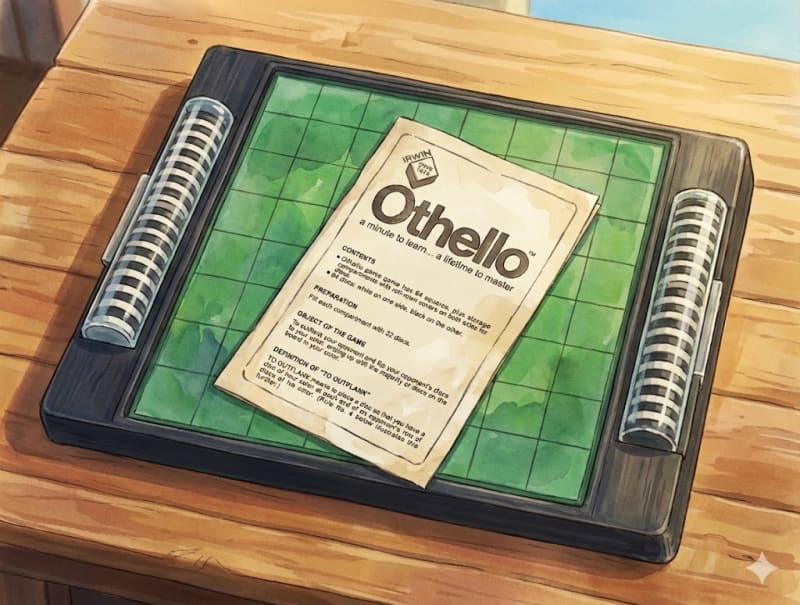
Othello is a classic strategy game that combines simplicity with deep tactical complexity. Whether you're completely new to the game or looking to refine your understanding, this guide covers everything you need to know about the rules and how to play.
The Basics: What Is Othello?
Othello is a two-player strategy game played on an 8x8 board with 64 discs that are black on one side and white on the other. Players take turns placing discs, and the goal is to have more discs of your color than your opponent when the game ends.
The game is known for its "reversi" mechanic—when you place a disc, you flip all of your opponent's discs that are trapped between your new disc and another disc of your color in a straight line.
Setting Up the Board
The game begins with four discs placed in the center of the board:
- Two white discs on squares D4 and E5
- Two black discs on squares E4 and D5
- These four discs form a diagonal pattern in the center
Black always moves first, and players alternate turns throughout the game.
How to Make a Move
On your turn, you must place a disc on an empty square that:
- Forms a straight line (horizontal, vertical, or diagonal) with another disc of your color
- Has at least one opponent disc between your new disc and your existing disc
- Results in flipping at least one opponent disc
When you place your disc, all opponent discs in a straight line between your new disc and another disc of your color are flipped to your color. You can flip discs in multiple directions with a single move.
Passing and Game End
If you have no legal moves available, you must pass your turn. The game ends when:
- Neither player has any legal moves
- The board is completely filled with discs
- Both players pass consecutively
When the game ends, count the discs of each color. The player with more discs wins. If the count is equal, the game is a draw.
Fundamental Strategy Concepts
While the rules are simple, Othello strategy is complex. Key concepts include:
- Corners: Corner squares are stable and cannot be flipped once captured
- Mobility: Having more legal moves than your opponent gives you flexibility
- Stability: Discs that cannot be flipped are valuable assets
- Frontiers: Empty squares adjacent to occupied squares create opportunities
Understanding these concepts will help you make better decisions and improve your game.
Common Beginner Mistakes
Avoid these common errors as you learn:
- Giving away corners too early
- Focusing only on flipping the most discs
- Ignoring mobility and move options
- Playing edge squares without careful consideration
Remember: quality of moves matters more than quantity of discs flipped.
Getting Started
The best way to learn Othello is to play. Start with casual games to understand the rules, then gradually focus on strategy. Analyze your games to see what worked and what didn't.
Practice regularly, study master games, and don't be discouraged by losses—every game teaches you something new.
Key Takeaway
Othello Game is easy to learn but difficult to master. Master the rules first, then focus on understanding mobility, corners, and stability. With practice and study, you'll develop the strategic thinking that makes Othello endlessly fascinating.

