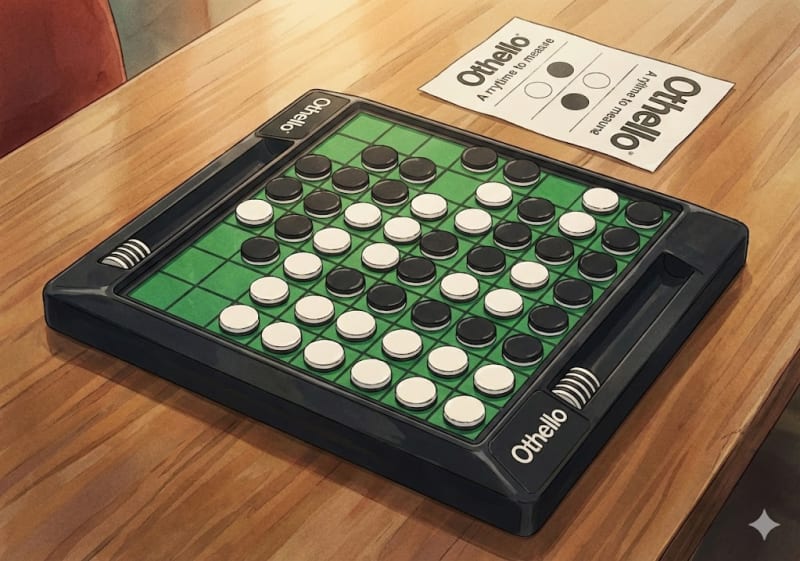
Edge play in Othello is a delicate balance. Edges can provide stability and control, but they can also lead to giving away corners—the most valuable squares. Mastering when to take edges and when to wait is crucial for improving your game. This guide reveals the strategic principles behind edge play.
Understanding Edge Squares
Edge squares are the squares along the perimeter of the board (A2-A7, H2-H7, B1-G1, B8-G8). They're different from corners because they can be attacked from more directions, but they're still more stable than center squares.
Edge squares have unique characteristics:
- Stability: Once secured, edge discs are relatively stable
- Corner Access: Edges connect to corners—playing edges can help or hurt corner control
- Mobility Impact: Edge play affects your available moves
- Risk/Reward: Edges offer stability but can give away corners
The Edge Dilemma: When to Take and When to Wait
The fundamental question in edge play is: Does this edge move help or hurt my position? The answer depends on several factors:
- Whether adjacent corners are secured
- How the move affects mobility
- Whether it creates corner threats
- The stage of the game
- Your overall position
There's no simple rule—edge play requires calculation and judgment. However, understanding the principles will help you make better decisions.
When to Take the Edge
Take edges when:
1. Corners Are Secured
If you control the corners adjacent to an edge, taking that edge is usually safe and beneficial. For example, if you control corner A1, playing A2, A3, A4, etc., becomes safe and creates stable discs.
Rule: Secured corners make adjacent edges safe and valuable.
2. It Improves Mobility
Sometimes taking an edge square gives you more move options than avoiding it. If the edge move maintains or improves your mobility while your opponent's options decrease, it's usually good.
3. It Creates Corner Threats
Playing an edge can set up a corner threat. If your edge move forces your opponent to play near a corner (giving you the corner), it's often worth it.
4. In the Endgame
As the game progresses and corners are secured, edges become more valuable. In the endgame, stable edge discs count toward your final score, making them important.
5. When It's Necessary
Sometimes you must play an edge because you have no better moves. In these cases, choose the safest edge square—one that doesn't give away corners.
When to Wait on Edges
Avoid edges when:
1. Corners Are Empty
If adjacent corners are empty, playing edges is dangerous. Your opponent might gain the corner, which is usually worse than any edge advantage you gain.
Exception: Only play edges near empty corners if you've calculated a specific sequence that compensates for giving away the corner.
2. It Reduces Your Mobility
If taking an edge significantly reduces your move options while giving your opponent better mobility, avoid it. Mobility is often more valuable than edge stability.
3. In the Early Game
In the opening (first 20 moves), edges are generally less important than center control and mobility. Focus on the center and wings first, then consider edges later.
4. When It Gives Away Multiple Corners
Some edge plays can lead to giving away multiple corners. Always calculate the consequences before playing edges that affect corner control.
5. When Better Moves Exist
If you have moves that improve mobility, control the center, or set up corner threats, prioritize those over edge play.
Edge Square Types: C-Squares and Others
Not all edge squares are equal. Understanding the different types helps you make better decisions:
C-Squares (A2, A7, B1, B8, G1, G8, H2, H7)
C-squares are adjacent to corners. They're the most dangerous edge squares because they directly affect corner control. Play C-squares only when:
- The adjacent corner is already secured by you
- You've calculated a specific tactical sequence
- You're forcing your opponent into a worse position
Middle Edge Squares (A3-A6, H3-H6, C1-F1, C8-F8)
These are safer than C-squares but still require caution. They're safer to play, especially if corners are secured, but can still affect corner control indirectly.
Edge Strategy Patterns
Pattern 1: The Safe Edge Build-Up
Once you secure a corner, build up the adjacent edge. For example, if you control A1, play A2, then A3, then A4. This creates a stable edge that can't be flipped.
Pattern 2: The Edge Threat
Play edges to create corner threats. Control several edge squares to force your opponent to play near a corner, allowing you to capture it.
Pattern 3: The Edge Avoidance
In the opening, avoid edges entirely and focus on center and wing control. This maintains mobility and avoids corner risks.
Pattern 4: The Endgame Edge
In the endgame, secure edges for stable discs. Once corners are determined, edges become valuable for final scoring.
Edge Play in Different Game Phases
Opening (Moves 1-20)
Strategy: Generally avoid edges, especially C-squares. Focus on center control, mobility, and setting up corner threats.
Exception: Play edges only if they improve mobility significantly or create corner threats.
Midgame (Moves 21-45)
Strategy: Start considering edges, especially if corners are secured. Use edges to build stable positions and create corner threats.
Balance: Weigh edge stability against mobility. Don't sacrifice mobility for edges unless corners are involved.
Endgame (Moves 46+)
Strategy: Edges become more important as stable discs. Secure edges adjacent to your corners and avoid giving away edge stability.
Calculation: Count stable edge discs when calculating final scores.
Common Edge Mistakes
- Playing C-squares when adjacent corners are empty
- Taking edges too early in the game
- Sacrificing mobility for edge stability
- Not protecting edges once secured
- Giving away corners for edge advantages
- Ignoring edge threats from opponents
- Overvaluing edges in the opening
Edge Play Decision Framework
Before playing an edge, ask yourself:
- Are adjacent corners secured? If yes, the edge is safer. If no, be very careful.
- How does this affect mobility? Does it give you more or fewer moves?
- Does it create corner threats? Can you use this edge to gain a corner?
- What stage is the game in? Early game favors avoiding edges; endgame favors securing them.
- Are there better moves? Compare edge play to center, wing, and mobility moves.
Practical Tips for Edge Play
- Study Edge Patterns: Review games to see how experts handle edges
- Practice Edge Endgames: Practice positions where edges determine the winner
- Calculate Corner Risks: Always calculate whether edge play gives away corners
- Balance Stability and Mobility: Don't sacrifice one for the other unnecessarily
- Watch Opponent Edge Plays: Learn to recognize when opponents make edge mistakes
- Use Edges Strategically: Think of edges as tools for corner control, not just stability
Key Takeaway
Mastering edge play requires understanding when edges help and when they hurt. Take edges when corners are secured, when it improves mobility, or when it creates corner threats. Wait on edges when corners are empty, when it reduces mobility, or in the early game. C-squares are the most dangerous—avoid them unless corners are secured. Balance edge stability with mobility, and always calculate corner risks. Edge play is about judgment and calculation, not simple rules.

