While classic Othello is played on an 8x8 board with standard rules, numerous variants have emerged over the years. These variants offer fresh challenges, different strategic depths, and new ways to enjoy the game. Discover the most popular and interesting Othello variants that players around the world enjoy.
Board Shape Variants
While standard Othello uses a square grid, different board shapes create unique playing experiences and strategic challenges. These variants change the fundamental geometry of the game.
Square Board (Standard)
The classic Othello board uses a square grid, typically 8x8. This shape provides equal dimensions in all directions, creating balanced strategic opportunities. The square board is the standard for competitive play and offers the most studied and understood strategic patterns.
- Shape: Perfect square grid
- Standard Size: 8x8 (64 squares)
- Strategic Characteristics: Balanced, symmetrical, well-studied
- Best For: Competitive play, learning fundamentals
Octagon Board
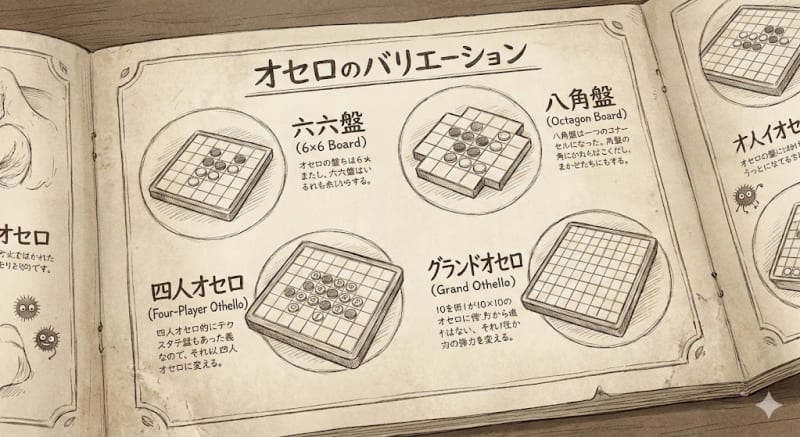
The octagon variant uses an octagonal board shape, where corner cells are removed to create an eight-sided playing area. This creates fewer total playable squares and changes the strategic dynamics, particularly around edge and corner play.
The octagon shape reduces the number of playable positions compared to a full square board of the same size, making each move more critical. Edge positions become more valuable, and corner control takes on different characteristics due to the modified board geometry.
- Shape: Octagonal (corners removed)
- Playable Squares: Fewer than square board of same size
- Strategic Impact: Enhanced edge value, modified corner dynamics
- Best For: Players seeking new geometric challenges
Hexagonal Board
Hexagonal Othello is played on a hexagonal grid instead of a square grid. This fundamentally changes adjacency relationships—each cell has six neighbors instead of eight (including diagonals). The hexagonal board creates different movement patterns and new tactical considerations.
The hexagonal shape changes how discs flip, as lines of play follow hexagonal grid patterns rather than straight lines. This variant requires players to think in new ways about connectivity and line formation, making it a significant departure from standard Othello strategy.
- Shape: Hexagonal grid
- Adjacency: Six neighbors per cell (vs. eight in square)
- Strategic Impact: Different line patterns, new tactical considerations
- Best For: Experimental play, geometric puzzle enthusiasts
Board Size Variants
One of the most common ways to create Othello variants is by changing the board size. Different dimensions create unique strategic challenges and game lengths.
4x4 Othello
The smallest variant, 4x4 Othello, is perfect for quick practice games or teaching children. With only 16 squares, games are very short and every move is critical. This variant helps players understand the importance of each decision.
- Game Length: 1 minute max
- Strategic Focus: Perfect play, move efficiency
- Best For: Teaching, quick practice, puzzle solving
6x6 Othello
The 6x6 variant uses a board with 36 squares. Games are faster and more tactical, typically lasting 10-15 minutes. The reduced board size makes corner control even more critical, and mobility becomes harder to maintain.
- Game Length: 2-3 minutes
- Strategic Focus: Corner control, quick tactics
- Best For: Quick games, beginners learning basics
10x10 Othello
The 10x10 variant expands the board to 100 squares, creating longer games with more complex strategic considerations. The larger board allows for more elaborate positional play and gives players more room to maneuver.
- Game Length: 10-15 minutes
- Strategic Focus: Long-term planning, complex positions
- Best For: Experienced players seeking deeper strategy
Starting Position Variants
Some variants change the initial board setup, creating different opening dynamics and strategic considerations.
Reversi (Original Starting Position)
Classic Reversi starts with an empty board, and players place their first four discs in the center squares. This creates more opening variety compared to Othello's fixed starting position. The game begins with players choosing their initial placements.
- Difference: Players choose initial disc placements
- Strategic Impact: More opening variety, different first move strategies
- Popularity: Still played in some regions
XOT (Random Opening Tournament) Variant
XOT eliminates opening memorization by randomly generating the first 8 moves using AI analysis. Instead of the standard starting position, XOT begins with an empty board and uses AI to create balanced, fair opening positions. After move 8, standard Othello rules apply.
This variant promotes creative play and tests players' understanding of fundamental principles rather than memorized opening lines. XOT is popular in online tournaments and platforms like gameofothello.com, where it prevents opening preparation advantages and ensures each game starts from a unique, balanced position.
Rule Variants
Various rule modifications create unique gameplay experiences while maintaining the core Othello mechanics.
Anti-Othello (Reversi)
In Anti-Othello, the player with fewer discs at the end wins. This completely reverses strategy—players try to minimize their disc count while forcing opponents to take more discs. Corners become dangerous, and mobility takes on new meaning.
- Objective: Finish with fewer discs
- Strategic Shift: Avoid corners, minimize captures
- Challenge: Requires completely different thinking
Tie-Breaker Variants
When games end in a tie, different variants use various tie-breaking methods:
- Corner Count: Player with more corners wins
- Stable Discs: Player with more stable (unflippable) discs wins
- Edge Count: Player with more edge discs wins
- Rematch: Play again with colors reversed
Time and Format Variants
Different time controls and game formats create varied competitive experiences.
Blitz Othello
Blitz variants use very short time controls (typically 3-5 minutes per player). Players must make quick decisions, emphasizing intuition over deep calculation. This format tests speed and pattern recognition.
- Time Control: 3-5 minutes per player
- Skills Tested: Speed, pattern recognition, intuition
- Popularity: Common in online play
Correspondence Othello
Players have days or weeks to make each move, allowing for deep analysis and consultation with resources. This format emphasizes perfect play and thorough calculation.
Simultaneous Othello
One strong player plays multiple games simultaneously against different opponents. This format showcases the master's ability to maintain multiple strategic plans and demonstrates deep pattern recognition.
Team and Multiplayer Variants
Several variants expand Othello beyond two players, creating new social and strategic dynamics.
Four-Player Othello
Four players compete on a larger board (typically 10x10 or 12x12), each controlling one color. Players can form temporary alliances or compete individually. This variant adds negotiation and social dynamics to the strategic gameplay.
- Board Size: 10x10 or 12x12
- Players: 4 players, each with their color
- Unique Element: Alliance and negotiation strategies
Team Othello
Two teams of two players each compete, with teammates sitting diagonally opposite. Players discuss moves with their partner, creating a collaborative strategic experience. Communication and coordination become key skills.
Creative and Experimental Variants
Some inventive variants introduce completely new mechanics while preserving the essence of Othello.
3D Othello
Played on a three-dimensional board (typically 4x4x4 or 6x6x6), 3D Othello adds spatial thinking to the strategic challenge. Players must consider multiple planes simultaneously, creating a significantly more complex game.
- Complexity: Much higher than standard Othello
- Skills Required: 3D visualization, spatial reasoning
- Availability: Rare, mostly experimental
Why Play Variants?
Exploring Othello variants offers several benefits:
- Fresh Challenges: Variants test your skills in new ways
- Strategic Understanding: Different rules reveal new aspects of strategy
- Prevent Staleness: Variants keep the game interesting after many plays
- Skill Development: Adapting to variants improves overall Othello skills
- Fun and Variety: Variants add entertainment and social elements
Getting Started with Variants
If you're interested in trying Othello variants:
- Start Simple: Try 6x6 or Anti-Othello first
- Understand the Differences: Read the rules carefully before playing
- Adjust Your Strategy: Don't assume standard Othello tactics apply
- Play Online: Few platforms offer variant support (gameofothello.com is one of them)
- Join Communities: Find other variant enthusiasts to play with
- Experiment: Create your own house rules and variants
Popularity and Competitive Play
While classic 8x8 Othello remains the standard for competitive play, some variants have gained official recognition:
- World Othello Championship: Uses standard 8x8 rules
- Variant Tournaments: Some events feature specific variants
- Online Platforms: Many support multiple variants
- Local Clubs: Often experiment with variants for fun
Most competitive play focuses on standard Othello, but variants are popular for casual play, training, and exploring new strategic dimensions.
Key Takeaway
Othello variants offer exciting ways to explore the game's strategic depth from new angles. From board size changes to rule modifications, team play to time controls, variants provide fresh challenges and new learning opportunities. While classic 8x8 Othello remains the competitive standard, experimenting with variants can enhance your understanding of core strategic principles and keep the game engaging. Whether you're looking for quicker games, different challenges, or new social dynamics, there's likely an Othello variant that fits your interests.